

Module: LCKFMOD | Version: 1.0 | Platforms: All
Overview
LCKFMOD provides integration with FMOD Studio, capturing game audio output for recording. This plugin hooks into the FMOD audio system to capture the final mixed output using a DSP node attached to the master channel group.Supported Channels
Requirements
- FMODStudio plugin for Unreal Engine
- FMOD Studio project configured in your game
Dependencies
Automatic Integration
The plugin automatically:- Detects FMOD Studio plugin presence
- Registers capture callback on the master bus
- Registers with the LCK audio system
Source Implementation
FLCKFMODSource
The core audio source class that captures game audio from the FMOD master channel group:Capture Point
LCKFMOD captures audio from the FMOD master bus after all mixing and effects processing:Technical Details
DSP-Based Capture
The plugin uses FMOD’s DSP system to intercept audio non-destructively:- A custom
FMOD::DSPis created and attached atFMOD_CHANNELCONTROL_DSP_TAILposition on the masterFMOD::ChannelGroup - The DSP callback reads audio data without modifying the output
- Audio callback runs on the FMOD audio thread
- Data is marshaled to the game thread via
AsyncTask - PCM format: 32-bit float, interleaved
DSP Lifecycle
- StartCapture — Creates a custom DSP, obtains the master
ChannelGroup, and adds the DSP at tail position - Audio callback — The DSP read callback copies PCM data and fires
OnAudioDataDelegate - StopCapture — Removes the DSP from the channel group and releases it
Configuration
Sample Rate
We recommend setting the sample rate explicitly to 48kHz rather than leaving it at 0 (auto):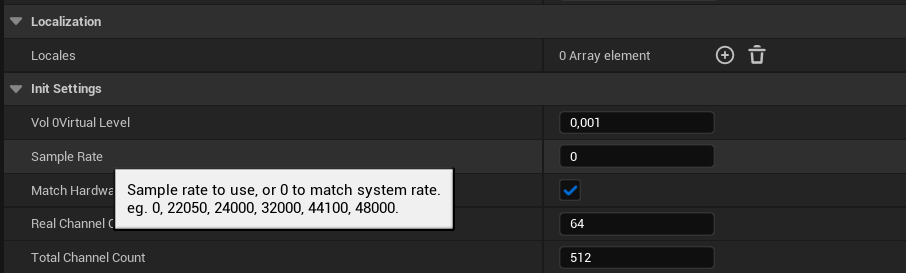
Output Format
Set FMOD Output Format to Stereo. The default 5.1 surround is not supported at this time.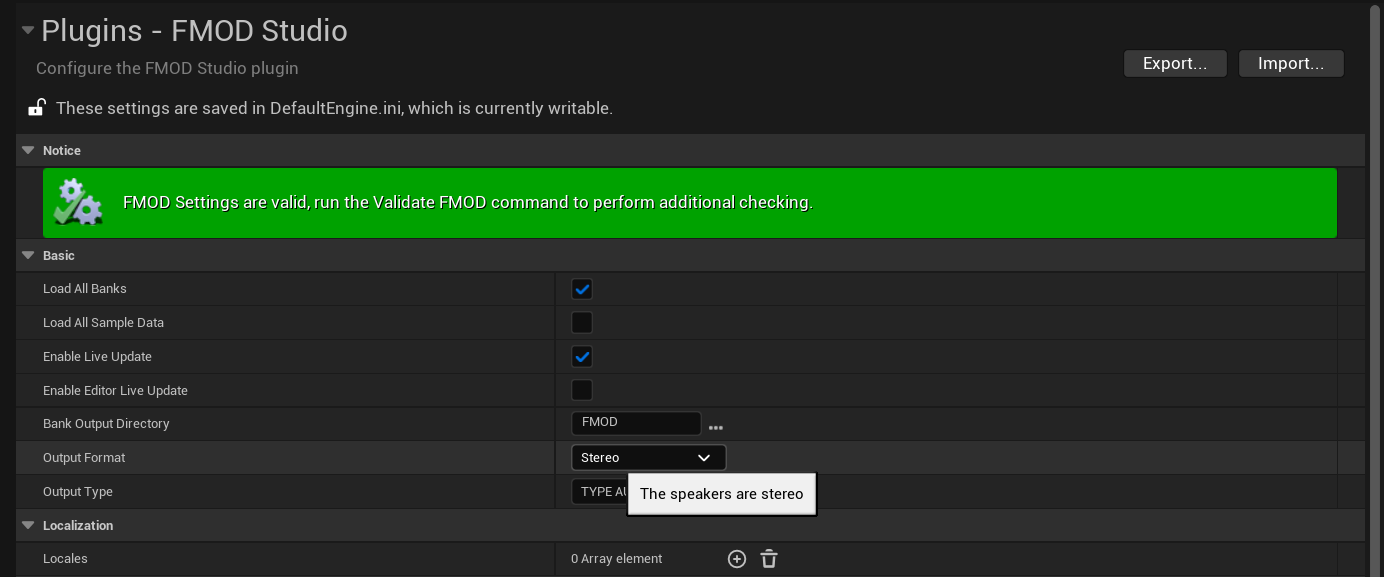
Performance
LCKFMOD has minimal performance impact:Compatibility
Troubleshooting
No audio captured
No audio captured
- Verify FMOD Studio plugin is enabled
- Check that audio is playing through FMOD
- Verify master bus is not muted
- Check LogLCKFMOD for errors
Audio distortion
Audio distortion
- Check sample rate matches between FMOD and encoder
- Verify buffer sizes are adequate
- Check for CPU overload in FMOD profiler
DSP not attaching
DSP not attaching
- Verify FMOD system is fully initialized before capture starts
- Check that
MasterGroupis valid - Look for FMOD error codes in LogLCKFMOD
Log Category
See Also
Audio Overview
Audio system architecture
Wwise
Alternative middleware integration